Showing posts with label Arcade. Show all posts

Thursday, January 5, 2017

Is This an Arcade or Vindex Toy?

Thursday, January 5, 2017
Sunny with Clear Skies
-7C  19.4 F


Is this an Arcade 
or Vindex Toy?


I received an e-mail from my friend Ed who is the owner of Antique Toys. He had a very nice Fokker cast iron toy, but was in a quandary. His O'Briens "Collecting Toys" book identified the toy as an Arcade, However, Ed's knowledge of these cast iron toys had characteristics of a Vindex toy.  Ed e-mailed me to see if I could find information in my Arcade toy catalogues of yore. Unfortunately, my 1936 Arcade catalogue and the other one had no photos of airplanes, so I couldn't help Ed much.The best that I could do  was to ask Ed's permission to use his photos of the toy, and ask any viewers if they could identify the toy.  So this is basically what today's post is all about.

If anyone out there has a toy like this and knows what it is, would you please e-mail me with your photos, and any catalogue page scan that would cross-reference the catalogue image with that of the actual toy.

The photo below is one of an Actual Fokker airplane that the toy photos below are based on.

The dimensions of Ed's toy are:

L x W x H:
3 7/8" x 4" x 1 7/8"
98 mm x 101 mm x 48 mm


Ed wrote a more thorough and interesting article about his Fokker toy than I did. So if you visit the website address below, you'll have more information about why Ed is not sure whether the toyu is an Arcade or a Vindex.


So this is my first post of 2017, and I hope someone out there in the Web 
World will be able to help Ed out.


Thanks for dropping by,
and as always,
Have a great part of the day or night,
Wherever you may be.

Stacey Bindman
toysearcher@gmail.com

Monday, December 5, 2016

Some Nice Toys from Vintage-Toymasters

Wednesday, December 7, 2016
Overcast with rain & snow
2 C 36 F


Last wek, I added a post about some nice toys from Vintage-Masters toys. When I returned to visit their ebay site, I came across a nice grouping of toys, that I've posted for today. There's a lot more there, but these are the selected ones.

1950's "Lopz Servicio Particular
Lithographed pressed steel
Length:  18" 467 mm

1920's Felix The Cat Fire Chief Car
Original, Largest Size, wood and metal
Length:  14"  355 mm

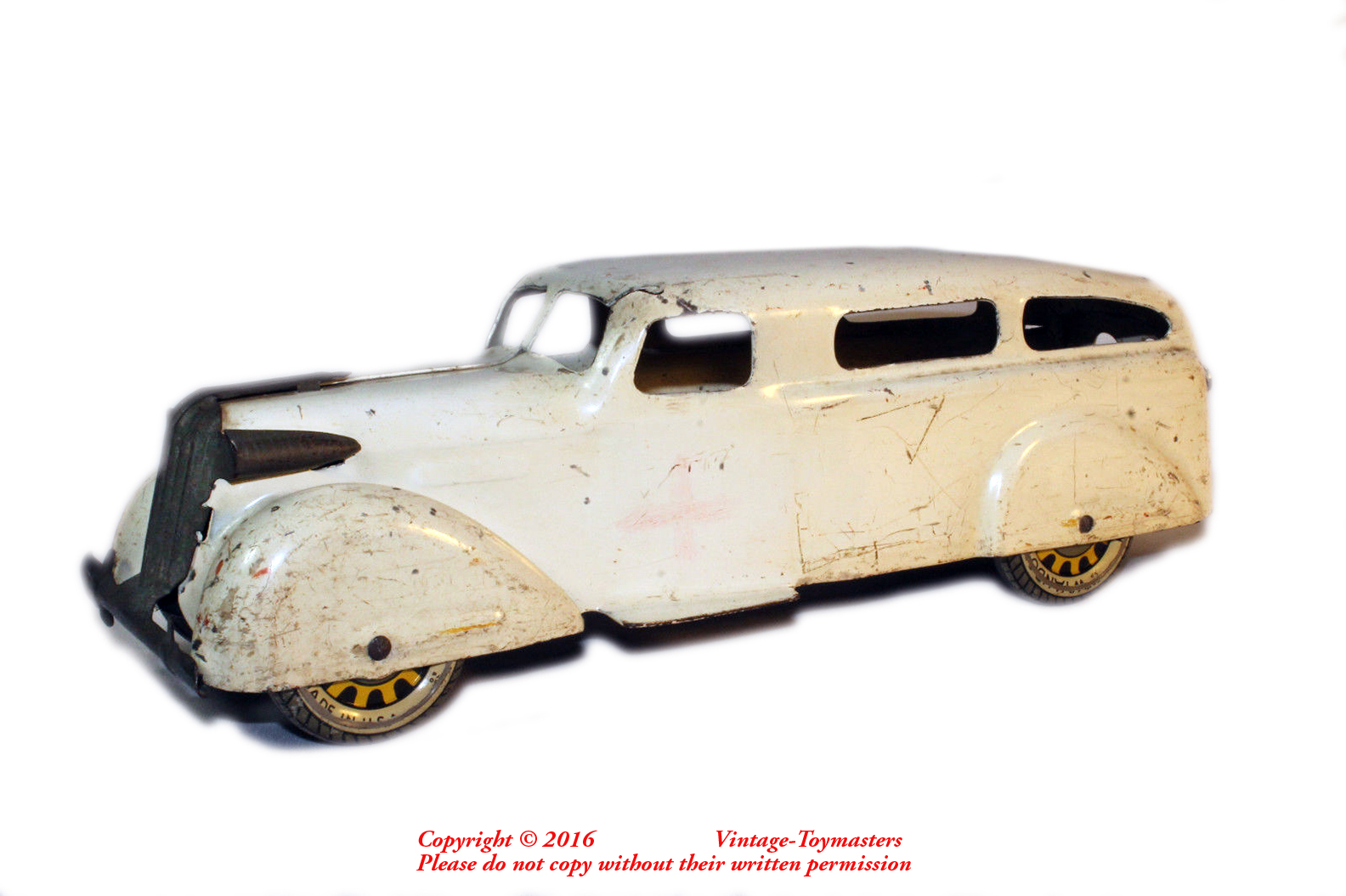
Wyandotte Ambulance
Painted pressed steel with lithographed tin artillery spoked wheels
Length:  11"

Turner Pressed Steel Roadster
painted pressed steel
Circa: 1920's
Length:  13 1/2"  342 mm


Slik Toys Oliver Row Crop 77 Tractor with Corn Picker
Painted diecast metal
Circa:  1950's
Length:  10"  254 mm

Arcade McCormick Deering Farmall Farm Tractor
Painted cast iron with nickel-plated figure
Circa:  1930's
Length:  5 1/2"  140 mm

Thanks for dropping by,
and always,
Have a great part of the day or night,
Wherever you may be.

Stacey Bindman
toysearcher@gmail.com


Sunday, November 20, 2016

Cast Iron Wreckers

Tuesday, November 22,2016
Overcast  with sunny periods
6 Celsius 41 Fahrenheit


Cast Iron Wreckers


As soon as the automobile was invented, there were bound to be accidents. As such the "wrecker" was invented to tow away the vehicles that were damaged in the accidents. Later on, the term "wrecker" was changed to "tow truck"- a milder word. As toys always replicated relief items, sure enough, the wreck toys came on to the marketplace. The major manufacturers of cast iron toys made these wreckers. Arcade was the most prolific, and the other manufacturers made them also, but to a lesser extent.  Kenton, Kilgore, Hubley and Champion all made these nice toys.

Some wreckers were simpler coming with only a hook, while others came with a simple winch. The larger Arcade wreckers came with the most sophisticated mechanism for both lifting and towing the "wrecked:"car or truck.

A Cadillac 1931 tow truck from Springfield, Mass., USA


The cast iron phenomena  was almost exclusively in the United States. There was one Swedish company by the name of Skogland & Olsen that made cast iron toys including the wrecker below.

The lithographed  tin manufacturers in the United States, such as Marx, and Chein also made wreckers, but I chose just to present the cast iron version today. In my search, I didn't find too many lithographed tin wreckers, but that's not to say that more weren't manufactured.

Thanks for dropping by, and as always,
Have a great part of the day or night,
Wherever you may be.

Stacey Bindman
toysearcher@gmail.com


Friday, November 11, 2016

Turner Auctions Next Auction

Friday, November 11, 2016
Remembrance Day 
Cloudy with some Sunny Periods
6 Celsius / 41 Fahrenheit


Turner Auctions  & Appraisals 
Next Auction (2016-11-12)


I  just decided to "squeeze" this post in before tomorrow. Turner Auctions & Appraisals has a fine set of toys up for auction tomorrow. The group of toys happens to be from the Anita & Selwick Hellman Collection collected over a period of 50 years.

Hubley # 610 painted cast iron  Town Car
with nickel-plated grill,headlights, & bumpers. 
Rubber Tires
Circa: 1930's
Length: 6 3/4"  172 mm


Hubley made 2 versions of the Studebaker car.
One was the # 608 sedan, while # 610 was the town car.
As well, they manufactured 2 sizes of the cars. One was the larger version of the # 610 measuring  6 5/8" (167 mm), while the smaller version was called the "Midget Line". THe catalogue numbers were #Q 324 (Sedan) & # 325 (Town Car). They both measured 4 1/4" (118 mm) in length.
If you were to bid on the Hubley Studebaker town car, it would be a good idea to write the auctioneer for the length of this item.


Arcade Cast Iron Cartoon Character (Andy Gump)
Painted cast iron with car & driver
Circa: 1920's-1930's
It's important to note the crank handle in the front of this item. 
Not all of these toys that you'd see at auction or on ebay would have this part. 
It's easy to break off.


Rare Dent Cast Iron Truck Double-Decker Bus
NIckel-plated tires
Length:  10 1/2" 262 mm
Circa: 1920's - 1930's


Freitag Painted Cast Iron Double-Decker Bus
Has passenger/driver inserts (One side missing some figures)
Length:  9 1/4"  235 mm
Circa: 1920's-1930's

Hubley Painted Cast Iron  Fire Trucks
Wheels repainted on long pumper truck
Circa: 1920's
Lengths:  7 7/8" - 14"  200 mm - 355 mm


The Hubley scans below are similar or identical to
the group of photos above. These catalogues
are from the Hubley Catalogues of the 1920's & 1930's


Wilkens Cast Iron Horse with Curved Bed Wagon
Painted cast iron, curved bed wagon, missing driver.
The "driver" shown  is for a car or truck!

Kenton cast iron Overland Circus Wagon
Painted cast iron horse drawn wagon, with driver & bear
Missing 2 horsemen
length: 13 1/2"  342 mm
Circa: 1920's

Once upon a time, a long time ago (1880's-1950's), circuses travelled by road and by train to different cities across North America. As time "marched on", cities got larger, and it was harder for the circuses to find space to set up their tents, or to present their show. Also, in the late 1970's to the present time, circuses became less popular. The animal  protectionists also made very one aware of the fact, that animals did not belong in cages or even in shoos. For some people, this kept them and their families from visiting the circus.

As a young child, my parents took myself and m brother and sister to the circus. By the mid-late 1950's the circus that came to Montreal would be presented indoors at the old Montreal Forum, where the famous Montreal Canadians (Canadiens in French) played.


Gong Bell Company Painted Cast Iron
Circa: 1890's
Length: 8 1/2"  226 mm


The toy above was manufactured by the Gong Bell Company, which was probably the largest and most famous of these pull toys. This toy could be seen all over North America. The toy was simple. A string was attached to the front of the toy, and as the toy was pulled, the bell or bells would chime with something inside the bell, or with a mechanism to hilt the bell. The peak popularity for these toys was from the 1880's - 1920's. As time advanced, toys replicated real things , and toy fire wagons, and carts became more popular. By the 1920's, with cars, trucks, and fire trucks, the bell toys were becoming less and less popular. 


 U.S. Hardware Oarsmen & Coxwain
Painted cast iron, Oars rotate when toy moves.
Pull toy.
Length:  9"  229mm
Like all for the other toy manufacturers presented today, most of them originated as hardware manufacturers before they entered the cast iron toy business. The hardware that they produced was for the home and office. Some of the items manufactured included hinges, handles, and door locks and keys.

This is the first time that I've seen this toy. That's not to say
that it is very rare or will yield a very high price at auction. Perhaps, its' just that I 've never come across the U.S. Hardware Company before.


Kenton Painted Cast Iron Fire Trucks with Painted Wheels
Circa: 1920's
Length"  5 5/8" - 6 5/8"  142 mm - 167 mm


As the horse and wagon began to be replaced by mechanized (motor) trucks, these early fire steam trucks were beginning to replace the horse and wagon fire wagons.

So treat's it for today,and you might want to venture over to the 
auction to see the many other cast iron toys available for auction.

Thanks for dropping by,'
and as always,
Have a great part of the day or night,
Wherever you may be.

Stacey Bindman
toysearcher@gmail.com


Tuesday, November 1, 2016

Match-ups of a 1923 Arcade Catalogue

Tuesday November 1, 2016
Cloud with Rain
9 Celsius 48 Fahrenheit


Match-Ups of a
1923 Arcade Catalogue


If you already don;t know, I like to match original toys with their original catalogue illustrations or photos. THe catalogue scans below are from an Arcade # 33 Catalogue from 1923.  The catalogue might even been a supplemental catalogue as the pages are numbered from 135-210.


By the early 1930's the automobile was already well-developed. Still though, the horse and buggy was relegated to the countryside,but in the big cities the automobile reigned supreme. ALong with the automobile came the taxi, and the "Yellow Cab Company" was the dominant company in many of the larger cities across North America.

The blue & white yellow cab below measures 5" (126 mm), 
and came in other colours besides yellow.


Reading the above written description, you'll notice that this toy was offered 
in colour choices of blue, ivory, and  bright red, with gold trim. The real "Fageol Safety Coach" was created to reduce the number of bus accidents that were common when the fist sets of busses were manufactured. 
"In 1921, Fageol became the first company to build a bus from the ground up. This new style bus was initially called "Safety Bus".[2] The goal was to build a bus that was resistant to overturning when cornering. It had a wide track, and was lower to the ground for ease of entry and exit. Following the successful introduction, the vehicles were renamed "Safety Coaches", a term intended to imply greater value.
Fageol trucks were well built and became favorites of the industry, owing in part to the dual range, mid-mounted transmission. This gearbox allowed for extreme ranges in gearing for slow speed heavy hauling and for highway speeds with lighter loads. These vehicles were easily spotted by the large number "7" painted on the front of the radiator."*
* Courtesy of Wikipedia


If you read the above written description, you'll see that this toy bus was offered 
 in  blue, green red and yellow colours with a gold side trim. 

Thanks for dropping by,
and as always,
Have a great part of the day or night,
wherever you may be.

Stacey Bindman
toysearcher@gmail.com


Tuesday, January 27, 2015

A Reader Sends Photos of His Identified Arcade Coupe

Tuesday, January 27, 2015
Overcast, very windy, and very cold

A Reader Sends Photos 
of His Identified Arcade Coupe

It's always great to hear from readers. I can see from my Google statistics that there are people who visit my website each day, however, it's always great to actually have someone write to me.  A few days ago, I heard from a Canadian reader - right "next door" in Ontario, the province next to mine, which is Quebec. Mr. Ken Keenan had written to say that he had a 70 year old (at least) cast iron toy car given to him when he was 3 years old. He was searching for the identity of his toy, and came across my blog and found his answer. As it turns out, it is a nice Arcade cast iron coupe from the 1930's or even earlier.

In His Own Words

I was given a cast iron car when I was three years old, that would be 70 years ago, how time goes by, and decided to look it up on the internet when I came upon your web site.
 
  There it was!  I couldn’t make out the name of the company stamped underneath so I made up some modeling clay and pressed it on the logo, and after tapping some flour on it and using a mirror to read the name I saw the word Arcade  and a serial number that looks like 13, but the serial number is hard to make out but two numbers for sure.
 
  When I was in my 40’s I took it from the curio cabinet and decided to paint it black as it looked pretty drab.  Years later I thought I would try to take the paint off with some paint remover and now it looks a speckled green more like when I got it originally.
 
  I once had a cast iron bank too that looked like the empire state building,  but somehow it got lost or thrown out.  I couldn’t seem to save money anyway.
 
  Your site was very helpful in identifying my car.  I remember many years ago on a radio program that they said cast iron cars some day could be worth a hundred dollars so hang on to them.  
 
  Anyway, thanks for the pictures and info, and if you would like some pictures of mine I would be only too glad to send you a few.
 
Yours truly,
Ken Keenan

I was going to do my  "usual" whitening effect for Ken's photos, but decided to pre sent all variations of Ken's photos.  Below is my usual "whitened" effect. Because the toy was on red, I had to remove the foundation. Once that was done, I removed the red colour that bounced from the  nice red fabric that Ken used on to the sides of the car. I should have removed  the red colouring of the fabric and leave something for the car to rest on.

As for the car, it certainly had been kept "as is" over all those years.  It really looks like something very old with the remnants of the green paint flakes.

Ken used this nice white material with a rectangular grid pattern on it. I removed the background, but left the grid as the foundation (what the item sits on). This foundation is a fine choice to photograph the toy. If you look at the rear of the car on this photo and the one below, you can see a "rumble seat". What's interesting here is that the rumble seat has been placed into 2 holes on each side of the car. It has small projections that rest in the holes, that allow for the seat to open and close.


I removed the area behind the black letter bin, but left the bin ad the foundation.  Black works well to present the toy, and since it's dark, the toy shows well  being a lighter colour. In the 1930's and earlier, Arcade made some of their cars with totally= cast iron wheels. Later cars and trucks would have metal rims with whitte or black rubber tires.

Here's Ken's car resting on the red fabric. I left the red on the side of the car to illustrate how a foundation will reflect colour on to the car.  Red also worked well, but a good idea would be to try to limit light on the car and darken the red. The red will be less noticeable, but allow for the red regal  to show the car as a "regal" item.

 What's great about these cast iron toys is that it takes forever for them to really rust out and return to the earth. 

The length of this car is 6 1/2" or  165 mm. If you do  a search on Liveauctioneers for 
Arcade Cast Iron Coupe or Arcade Cast Iron Rumble Coupe, 
you'll find images of the same toy, in various degrees of condition.


You may find  this toy in better condition when you go to Liveauctioneers, but for Ken, and for myself, the personal meaningful value is more important that the condition of the item.  I have some old fishing reels that my father gave me and my brother, and some that We inherited when my father passed on. They're not in the best condition, nor they are the most valuable, but there were my father's.

What's more is that they still work and can catch fish, and they're all metal, not the plastic that one finds today.

Some things are not worth changing regardless as to how old or in what condition they are!


Thanks for visiting and as always
have a great part of the day or night,
wherever you may be,
Stacey Bindman
toysearcher@gmail.com